
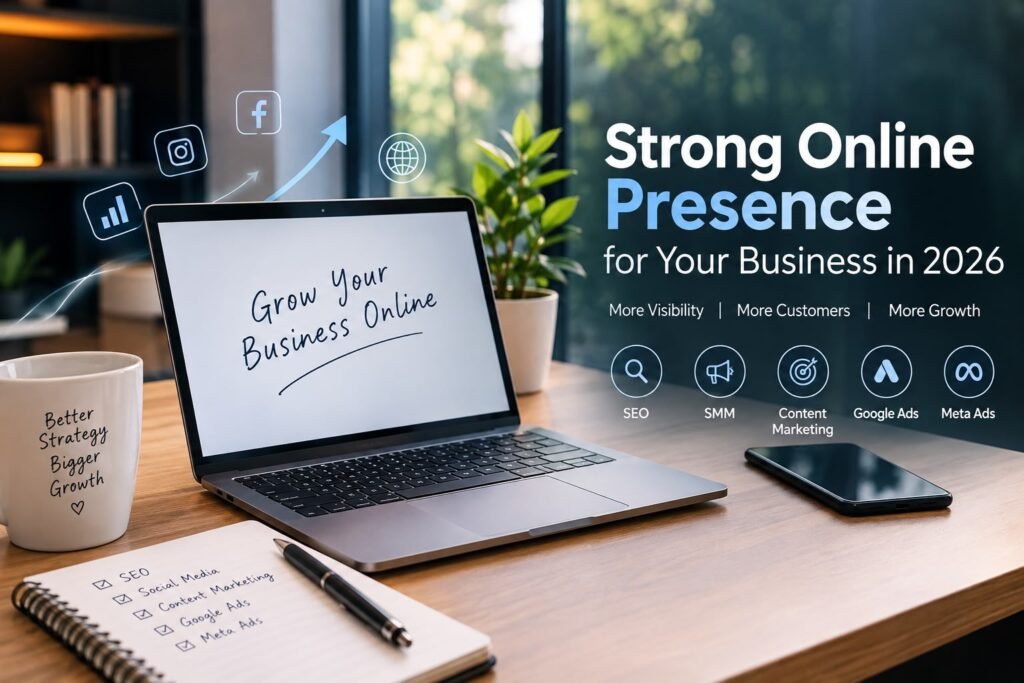
A strong online presence for your business in 2026 can help you reach more customers, build trust, and grow your brand in the competitive digital world.
In 2026, having a strong online presence is no longer optional for businesses. Whether you are running a small local business, a startup, a service-based company, or a growing brand, your customers are already online.
Strong Online Presence for Your Business in 2026
People use Google to search for products and services, Instagram to discover brands, Facebook to connect with businesses, YouTube to learn about products, and websites to find detailed information before making a purchase.
This is why every business needs to think seriously about its digital presence.
A strong online presence helps a business become more visible, build credibility, connect with the right audience, and create opportunities for long-term growth.
But building an online presence is not simply about creating an Instagram account or publishing a website. It requires a proper strategy that combines SEO, social media marketing, content marketing, paid advertising, branding, and customer engagement.
Strong Online Presence for Your Business in 2026
In this blog, let’s explore how you can build a strong online presence for your business in 2026.
What Is an Online Presence?
An online presence refers to everything people can find about your business on the internet.
This can include:
-
- Your website
-
- Google Business Profile
-
- Instagram account
-
- Facebook page
-
- LinkedIn profile or company page
-
- YouTube channel
-
- Online reviews
-
- Blog content
-
- Search engine results
-
- Online advertisements
Strong Online Presence for Your Business in 2026
When someone searches for your business online, your online presence determines what they see and how they perceive your brand.
A professional and consistent online presence can create trust, while an incomplete or outdated presence can make potential customers move to another business.
Why Is a Strong Online Presence Important in 2026?
Consumer behaviour continues to change as technology develops.
Before purchasing a product or service, customers often search online, compare options, read reviews, and check social media profiles.
This means your business needs to be visible at different stages of the customer’s journey.
A strong online presence can help you:
-
- Reach more potential customers
-
- Increase brand awareness
-
- Build customer trust
-
- Generate leads
-
- Increase website traffic
-
- Improve search visibility
-
- Promote products and services
-
- Communicate with customers
-
- Build a recognizable brand
The goal is not simply to be everywhere.
The goal is to be visible in the right places to the right audience.
-
- Create a Professional Website
Your website is one of the most important parts of your online presence.
Think of your website as your business’s digital home. It provides customers with important information about who you are, what you offer, and how they can contact you.
A professional website should be:
-
- Easy to navigate
-
- Mobile-friendly
-
- Fast-loading
-
- Visually attractive
-
- Easy to understand
-
- Search-engine friendly
-
- Secure
-
- Simple to contact
Your website should clearly communicate your services and give visitors a reason to take action.
For example, you can include:
Home – Introduce your brand and what you offer.
About – Tell your story and build credibility.
Services – Explain your products or services.
Blog – Share useful information and improve search visibility.
Contact – Make it easy for customers to reach you.
A website that provides a good user experience can become one of your most valuable digital marketing assets.
-
- Focus on Search Engine Optimization
Search Engine Optimization, commonly known as SEO, is another important part of building a strong online presence.
SEO helps improve the visibility of your website in search engine results.
Imagine someone searching for a service related to your business. If your website appears when they search for that service, you have an opportunity to attract a potential customer.
SEO involves several areas, including:
-
- Keyword research
-
- Website optimization
-
- Quality content
-
- On-page SEO
-
- Technical SEO
-
- Internal linking
-
- Local SEO
-
- Image optimization
For local businesses, Local SEO can be particularly useful.
For example, a business serving customers in Malappuram can create relevant content around its location and services to improve its chances of being discovered by people searching for those services locally.
SEO usually requires consistency and patience. It is not about getting instant results; it is about building sustainable online visibility.
-
- Build a Strong Social Media Presence
Social media is one of the most powerful ways to connect with customers.
Platforms such as Instagram, Facebook, LinkedIn, and YouTube allow businesses to communicate directly with their target audience.
However, simply creating an account is not enough.
Your business needs a clear social media strategy.
Start by identifying where your target audience spends most of their time.
Then create content that is relevant to them.
Your social media content can include:
-
- Educational posts
-
- Reels
-
- Product demonstrations
-
- Customer testimonials
-
- Behind-the-scenes content
-
- Tips and tutorials
-
- Frequently asked questions
-
- Brand stories
-
- Offers and promotions
Consistency is also important.
You don’t need to post every hour. Instead, focus on creating valuable content regularly.
A strong social media presence should make your audience understand your brand, trust your business, and remember you when they need your product or service.
-
- Create Valuable Content
Content marketing is an important part of digital marketing.
Content gives your business an opportunity to educate, inform, and connect with your audience.
Instead of constantly saying “Buy our product,” businesses can create content that solves customer problems.
For example, a digital marketing professional could create blogs about:
-
- SEO tips
-
- Social media strategies
-
- Google Ads
-
- Meta Ads
-
- Content marketing
-
- Branding
-
- Online business growth
A clothing brand could create content about styling tips.
A fitness brand could share educational information about workouts.
A restaurant could share recipes, food stories, or behind-the-scenes content.
The important thing is to create content that your target audience actually wants to consume.
Good content can also support SEO and social media marketing at the same time.
-
- Use Google Business Profile for Local Visibility
For businesses that serve a specific location, Google Business Profile can be extremely valuable.
When people search for a local business, they may see information such as:
-
- Business name
-
- Location
-
- Opening hours
-
- Phone number
-
- Website
-
- Photos
-
- Customer reviews
Keeping this information accurate and updated can make it easier for potential customers to find and contact your business.
Businesses should also encourage genuine customer reviews and respond professionally to customer feedback.
For a local business in Malappuram, maintaining a strong local online presence can help connect the business with nearby customers.
-
- Invest in Paid Advertising
Organic marketing is valuable, but paid advertising can help businesses reach targeted audiences more quickly.
Two popular advertising platforms are:
Google Ads
and
Meta Ads
Google Ads can help businesses reach people who are actively searching for particular products or services.
Meta Ads can help businesses reach targeted audiences across platforms such as Facebook and Instagram.
Paid advertising can be used for:
-
- Brand awareness
-
- Website traffic
-
- Lead generation
-
- Product promotion
-
- Sales
-
- Event promotion
-
- Retargeting
However, simply spending money on advertisements does not guarantee success.
Campaigns need proper targeting, compelling ad copy, relevant visuals, appropriate landing pages, and continuous optimization.
-
- Make Your Brand Consistent
Branding plays an important role in building recognition.
Your business should have a consistent visual and communication style across different platforms.
This includes:
-
- Logo
-
- Colours
-
- Fonts
-
- Images
-
- Tone of voice
-
- Content style
-
- Brand messaging
For example, if your website has a professional style but your social media pages look completely different, customers may find it difficult to recognize your brand.
Consistency helps create a stronger identity.
Over time, people can begin to recognize your business simply by seeing your colours, design, style, or messaging.
-
- Use Video Content
Video has become an important part of online marketing.
Short-form videos such as Reels and other video formats can help businesses capture attention quickly.
Businesses can use videos to:
-
- Demonstrate products
-
- Explain services
-
- Answer questions
-
- Share tutorials
-
- Introduce team members
-
- Show behind-the-scenes moments
-
- Share customer experiences
You don’t always need expensive equipment.
A smartphone, good lighting, clear audio, and useful content can be enough to start.
The focus should be on providing value rather than simply trying to make every video look perfect.
-
- Engage With Your Audience
Digital marketing should not be one-way communication.
Businesses should also interact with their audience.
When someone comments on your post, ask a question, sends a message, or leaves a review, responding appropriately can help build stronger relationships.
Audience engagement can include:
-
- Replying to comments
-
- Answering messages
-
- Responding to reviews
-
- Asking questions
-
- Conducting polls
-
- Collecting feedback
-
- Sharing user-generated content
Customers want to feel that there are real people behind a brand.
Good communication can turn a one-time customer into a loyal customer.
-
- Use Analytics and Data
One of the biggest advantages of digital marketing is that performance can be measured.
Instead of guessing whether your marketing is working, you can analyse data.
Important metrics can include:
-
- Website traffic
-
- Search impressions
-
- Click-through rate
-
- Social media engagement
-
- Ad clicks
-
- Leads
-
- Conversions
-
- Cost per lead
-
- Return on advertising spend
Analysing this information helps businesses understand what is working and what needs improvement.
For example, if one type of social media content receives significantly more engagement than another, you can create more content around that topic.
Data helps turn digital marketing from guesswork into a more informed strategy.
-
- Optimize for Mobile Users
A large number of people access the internet through smartphones.
Therefore, your online presence must work properly on mobile devices.
Your website should be responsive and easy to navigate on smaller screens.
Check:
Strong Online Presence for Your Business in 2026
-
- Text size
-
- Button size
-
- Image quality
-
- Page loading speed
-
- Navigation
-
- Contact forms
If a customer opens your website on a smartphone and struggles to use it, they may leave immediately.
A mobile-friendly experience can improve usability and create a better impression of your brand.
-
- Build Trust Through Reviews and Testimonials
People often look at other customers’ experiences before choosing a business.
Reviews and testimonials can therefore play an important role in building credibility.
You can showcase genuine testimonials through:
-
- Your website
-
- Google Business Profile
-
- Social media
-
- Case studies
Never underestimate the power of customer experience.
A potential customer may be more confident choosing a business when they see that other customers have had positive experiences.
-
- Keep Your Online Presence Updated
An outdated online presence can create a negative impression.
Strong Online Presence for Your Business in 2026
Imagine visiting a business website and finding old contact information, outdated offers, broken links, or inactive social media profiles.
It can make the business appear less reliable.
Regularly check your:
-
- Website
-
- Social media profiles
-
- Contact information
-
- Business hours
-
- Services
-
- Pricing information
-
- Images
-
- Blog posts
Keeping everything updated shows that your business is active and professional.
-
- Understand Your Target Audience
One of the most important parts of digital marketing is understanding your audience.
Before creating content or advertisements, ask:
Who are my customers?
What problems do they have?
What are they looking for?
Which platforms do they use?
What type of content interests them?
Why should they choose my business?
Understanding these questions can help you create more relevant marketing campaigns.
Instead of trying to reach everyone, focus on the people who are most likely to become your customers.
Common Mistakes Businesses Should Avoid
While building an online presence, businesses should avoid several common mistakes.
Posting Without a Strategy
Posting random content without knowing the purpose can make marketing ineffective.
Ignoring SEO
Having a beautiful website is not enough if people cannot find it through search engines.
Focusing Only on Followers
A large follower count does not automatically mean business success. Engagement, leads, and conversions are also important.
Inconsistent Branding
Changing your visual identity and messaging constantly can confuse your audience.
Ignoring Customers
Not responding to messages, comments, or reviews can damage customer relationships.
Expecting Instant Results
Digital marketing requires time, testing, consistency, and optimization.
A Simple Digital Marketing Strategy for 2026
If you are just starting, don’t try to do everything at once.
Start with a simple strategy.
Step 1: Define Your Goal
Decide what you want to achieve.
Strong Online Presence for Your Business in 2026
For example:
-
- More leads
-
- More sales
-
- More website visitors
-
- Brand awareness
-
- More local customers
Step 2: Identify Your Audience
Understand who your ideal customer is.
Step 3: Build Your Website
Create a professional, mobile-friendly website.
Step 4: Start SEO
Research relevant keywords and optimize your website content.
Step 5: Choose Social Media Platforms
Focus on the platforms where your audience is active.
Step 6: Create Valuable Content
Publish useful and engaging content consistently.
Step 7: Test Paid Advertising
Use Google Ads or Meta Ads when paid promotion makes sense for your goals.
Step 8: Measure Results
Analyse your performance and improve your strategy based on data.
The Role of a Digital Marketer
Building and managing an online presence can become challenging when you’re running a business at the same time.
This is where a digital marketer can help.
Strong Online Presence for Your Business in 2026
A digital marketer can assist with areas such as:
-
- SEO
-
- Social Media Marketing
-
- Content Marketing
-
- Google Ads
-
- Meta Ads
-
- Digital strategy
-
- Online brand building
- Performance analysis
Strong Online Presence for Your Business in 2026
Instead of treating every platform separately, a digital marketer can help connect different marketing activities into one overall strategy.
Final Thoughts
Building a strong online presence for your business in 2026 is about much more than simply being active on social media.
It requires a combination of strategy, consistency, valuable content, SEO, social media marketing, paid advertising, branding, customer engagement, and data analysis.
Businesses that understand their audience and consistently provide value have a better opportunity to build trust and grow in the digital marketplace.
You don’t need to implement everything on the first day.
Start with the basics.
Create a professional website. Build your social media presence. Improve your SEO. Create useful content. Understand your audience. Test different strategies. Measure your results and continue improving.
The digital world is constantly changing, but one thing remains important:
Businesses need to be where their customers are.
By building a clear and consistent online presence, your business can become easier to discover, easier to trust, and better positioned for long-term growth.
Start building your digital presence today—because your next customer could already be searching for you online.
⸻
Frequently Asked Questions
What is the best way to build an online presence for a business?
Start with a professional website, SEO, social media profiles, valuable content, and a clear digital marketing strategy. Then use analytics to understand what works and improve your approach.
Is social media enough for a business?
No. Social media is important, but a strong online presence should also include a website, SEO, local search visibility, content marketing, and other suitable digital channels.
How long does it take to build an online presence?
Building a strong online presence is an ongoing process. Some activities, such as paid advertising, can generate visibility quickly, while SEO and organic brand building usually require consistent effort over time.
Why is SEO important for businesses?
SEO helps businesses improve their visibility in search engines and reach people who are actively searching for relevant products or services.
Should small businesses use paid advertising?
Paid advertising can be useful when it matches the business’s goals and budget. Google Ads and Meta Ads can help businesses reach targeted audiences and generate traffic or leads.
Can a digital marketer help build an online presence?
Yes. A digital marketer can help businesses plan and manage strategies involving SEO, social media marketing, content marketing, Google Ads, Meta Ads, and other digital channels.
What is the most important part of digital marketing?
There is no single strategy that works for every business. Understanding your target audience and creating a strategy around their needs is one of the most important foundations of digital marketing.
⸻
strong online presence for your business in 2026
Strong Online Presence for Your Business in 2026
Learn how to build a strong online presence for your business in 2026 using SEO, social media, content marketing, Google Ads, Meta Ads, and effective digital strategies.