
Introduction
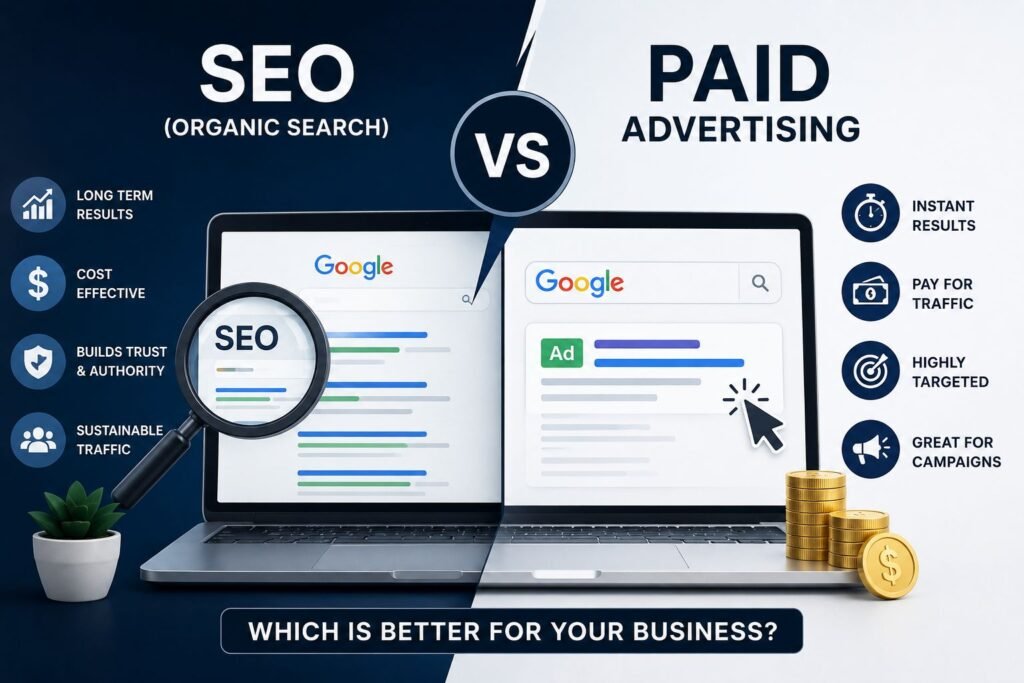
SEO vs Paid Advertising is an important decision for businesses looking to attract customers and build a successful online presence.
In today’s digital-first business environment, having an online presence is essential for attracting customers and building a successful brand. When people need a product or service, one of the first things they often do is search online. They may use Google to find information, compare businesses, read reviews, or make a purchase. This creates a major opportunity for businesses to reach potential customers through digital marketing.
Two of the most important strategies for increasing online visibility are Search Engine Optimization (SEO) and Paid Advertising. Both strategies can help businesses attract website visitors, generate leads, increase sales, and grow their online presence. However, they work in very different ways.
SEO focuses on improving a website so that it can appear naturally in search engine results. Paid advertising, on the other hand, involves paying platforms such as Google to display advertisements to selected audiences.
The question many business owners ask is: Which is better—SEO or paid advertising?
There is no single answer. The right choice depends on the business, goals, budget, target audience, competition, and desired timeline. Understanding the differences between SEO and paid advertising can help businesses make better marketing decisions.
SEO vs Paid Advertising
What Is SEO?
Search Engine Optimization, commonly known as SEO, is the process of improving a website and its content to increase its visibility in organic search engine results.
When users search for something on Google, the search engine analyzes many factors to determine which pages are most relevant and useful for that search. SEO helps businesses improve their chances of appearing in these results.
For example, imagine a person searches for “best digital marketing services for small businesses.” A digital marketing professional who has optimized their website and created useful content around relevant topics may have an opportunity to appear in the search results.
SEO generally involves several areas, including keyword research, content optimization, technical SEO, website structure, internal linking, page speed, mobile usability, and building website authority.
Unlike paid advertising, businesses do not pay Google for every organic click. However, SEO requires time, knowledge, consistency, and ongoing optimization.
What Is Paid Advertising?
Paid advertising is a digital marketing method where businesses pay advertising platforms to promote their products or services.
One of the most popular forms is Google Ads, where businesses can create advertisements that may appear when users search for relevant keywords.
For example, a company offering website design services could create an advertisement targeting searches related to website design. When a potential customer searches for a relevant term, the advertisement may appear in a prominent position.
Businesses can also use paid advertising on social media platforms such as Facebook and Instagram. These campaigns can be used for brand awareness, website traffic, lead generation, product promotion, and sales.
Paid advertising can provide faster visibility compared with SEO, but businesses generally need to continue spending money to maintain that paid traffic.
SEO vs Paid Advertising
SEO vs Paid Advertising: The Main Difference
The biggest difference between SEO and paid advertising is how visibility is achieved.
With SEO, a business works to earn visibility through organic search results. With paid advertising, a business pays for advertising space.
SEO is generally considered a long-term strategy, while paid advertising can provide faster short-term visibility.
For example, a new website may take time to build organic search visibility through SEO. A paid advertising campaign, however, can potentially start bringing targeted visitors soon after it is launched.
Both strategies have advantages and limitations, which is why businesses should evaluate them based on their specific goals.
SEO vs Paid Advertising
The Benefits of SEO
-
- Long-Term Visibility
One of the major advantages of SEO is its potential to generate long-term visibility.
A high-quality article or well-optimized website page can continue attracting organic visitors after it has been published. This makes SEO valuable for businesses interested in sustainable online growth.
However, rankings are not permanent. Search engine algorithms, competitors, and user behavior can change, so businesses need to continue maintaining and improving their SEO.
-
- Organic Traffic
SEO can help businesses attract organic traffic without paying for every individual click.
When a website ranks for relevant keywords, users can discover it naturally through search engines.
This can be particularly valuable for businesses that regularly receive search traffic from customers looking for their products or services.
-
- Builds Credibility
Users often view businesses that appear prominently in search results as established or trustworthy, although rankings alone do not guarantee credibility.
High-quality content can strengthen this effect by providing useful information and demonstrating expertise.
For example, a digital marketing website that regularly publishes informative articles about SEO, social media, and advertising can establish itself as a knowledgeable resource.
-
- Supports Content Marketing
SEO and content marketing work closely together.
Businesses can create blog posts, guides, FAQs, case studies, and other resources based on topics their target customers are searching for.
This content can attract organic visitors while also educating potential customers.
-
- Can Be Cost-Effective Over Time
SEO requires investment in strategy, content, tools, technical improvements, and expertise. However, once a website gains strong organic visibility, it can potentially generate significant traffic without paying for every click.
This makes SEO attractive for businesses focused on long-term growth.
SEO vs Paid Advertising
The Limitations of SEO
SEO also has disadvantages.
The biggest challenge is time. SEO usually does not produce significant results immediately. A new website may need months of consistent effort before seeing substantial improvements.
Competition is another challenge. Some keywords are highly competitive, making it difficult for smaller websites to rank quickly.
Search engine algorithms can also change, meaning businesses must continually monitor and improve their websites.
Therefore, SEO is not a quick solution. It is a long-term investment.
SEO vs Paid Advertising
The Benefits of Paid Advertising
-
- Faster Visibility
One of the biggest advantages of paid advertising is speed.
Businesses can launch campaigns and potentially start reaching relevant audiences much faster than they can build organic search rankings.
This makes paid advertising useful for new product launches, promotions, events, seasonal offers, and businesses that need immediate traffic.
-
- Precise Targeting
Paid advertising platforms offer powerful targeting options.
Businesses can target audiences based on factors such as location, interests, demographics, search intent, and online behavior, depending on the advertising platform and campaign type.
This can help businesses reach people who are more likely to be interested in their products or services.
-
- Budget Control
Businesses can set budgets for advertising campaigns and control how much they are willing to spend.
This allows even smaller businesses to begin with a limited budget, test their campaigns, analyze performance, and make adjustments.
However, setting a budget does not automatically make a campaign profitable. Proper targeting, creative quality, landing pages, and conversion tracking are important.
-
- Measurable Results
Paid advertising provides detailed performance data.
Businesses can monitor metrics such as impressions, clicks, click-through rate, cost per click, conversions, and return on advertising spend.
This information can help marketers understand how campaigns are performing and where improvements are needed.
-
- Useful for Specific Campaigns
Paid advertising is especially useful when a business has a specific objective.
For example, a company launching a new course may use paid ads to generate registrations. An online store may advertise a particular product. A local business may use advertising to generate enquiries.
The ability to create campaigns around specific objectives makes paid advertising highly flexible.
SEO vs Paid Advertising
The Limitations of Paid Advertising
The main limitation of paid advertising is cost.
Businesses usually need to continue investing in advertising to maintain their paid traffic. When a campaign stops, the traffic generated directly through that campaign may also decline.
Competition can also increase advertising costs. Popular keywords and audiences may become expensive, particularly in competitive industries.
Poorly managed campaigns can waste money. Businesses may spend on clicks that do not result in leads or sales if targeting, messaging, or conversion processes are not properly optimized.
Therefore, paid advertising should be treated as an investment that requires monitoring and optimization rather than simply an expense.
SEO or Paid Advertising: Which Gives Faster Results?
If speed is the main priority, paid advertising generally has an advantage.
A well-prepared advertising campaign can begin generating impressions and clicks soon after launch. SEO usually takes longer because search engines need time to discover, evaluate, and rank content.
For example, a new business launching a service next week may benefit from paid advertising if it needs immediate visibility.
At the same time, the business can begin SEO to build long-term organic visibility.
This combination allows the business to address both immediate and future marketing needs.
SEO vs Paid Advertising
Which Is More Cost-Effective?
The answer depends on the business and how the strategies are implemented.
Paid advertising requires direct spending on campaigns. SEO requires investment in content, optimization, expertise, and time.
If a business has a strong website and consistently ranks for valuable keywords, SEO can generate substantial organic traffic over time.
Paid advertising, meanwhile, can be highly effective when campaigns are carefully optimized and produce profitable conversions.
Instead of asking which strategy is always cheaper, businesses should ask:SEO vs Paid Advertising
Which strategy provides the best return for our specific goals and audience?
Which Is Better for Small Businesses?
Small businesses can benefit from both SEO and paid advertising.
SEO can help small businesses build long-term visibility and attract customers searching for their products or services.
Paid advertising can help them compete for attention and generate traffic without waiting for organic rankings.
For a local business, for example, SEO can help improve visibility for location-based searches, while paid campaigns can promote special offers or generate enquiries.
The ideal approach depends on budget, competition, business goals, and customer behavior.
SEO and Paid Advertising Work Better Together
Many businesses make the mistake of treating SEO and paid advertising as competitors.
In reality, they can complement each other.
SEO can build long-term organic visibility, while paid advertising can generate immediate traffic and support short-term campaigns.
Businesses can also use information from paid campaigns to improve their SEO strategy. For example, if certain keywords perform well in paid advertising, those topics may provide useful ideas for future organic content.
Similarly, organic search data can help businesses understand what customers are searching for and create more relevant advertising campaigns.
Combining both strategies can create a stronger and more balanced digital marketing approach.
SEO vs Paid Advertising
When Should a Business Focus on SEO?
A business may want to prioritize SEO when:
-
- It wants long-term organic traffic.
-
- Customers regularly search for its products or services.
-
- It has useful information that can be turned into content.
-
- It wants to build authority in its industry.
-
- It is prepared to invest time in long-term growth.
-
- It wants to reduce dependence on paid traffic over time.
SEO is particularly valuable for businesses that want sustainable online visibility.
When Should a Business Use Paid Advertising?
Paid advertising may be a good choice when:
-
- Immediate visibility is important.
-
- The business is launching a new product or service.
-
- There is a limited-time promotion.
-
- The business needs leads quickly.
-
- The business wants to test a market.
-
- The target audience can be clearly defined.
-
- The business has a suitable advertising budget.
Paid advertising can provide flexibility and speed, making it useful for both short-term campaigns and ongoing customer acquisition.
Common Mistakes Businesses Should Avoid
One common mistake is expecting SEO to produce immediate results.
SEO is a long-term process, and businesses should focus on creating useful content and improving their websites consistently.
Another mistake is running paid advertising without tracking conversions. Clicks and impressions are useful, but businesses ultimately need to understand whether advertising is producing meaningful business outcomes.
Targeting too broad an audience can also waste advertising budgets. Businesses should define their ideal customers as clearly as possible.
Another mistake is sending advertising traffic to a poor landing page. Even a successful advertisement may fail if the website is slow, confusing, difficult to navigate, or lacks a clear call to action.
How to Choose the Right Strategy
Businesses should consider five important factors before choosing between SEO and paid advertising.
First, consider the goal. Is the goal immediate leads or long-term visibility?
Second, consider the budget. How much can the business invest consistently?
Third, consider the competition. How difficult will it be to rank organically or advertise competitively?
Fourth, consider the customer journey. How do customers usually discover and evaluate the product?
Finally, consider the timeline. Does the business need results immediately, or can it invest in long-term growth?
Answering these questions can help businesses choose a strategy that fits their situation.
SEO vs Paid Advertising
The Future of Search Marketing
Search behavior continues to evolve. People are using traditional search engines, social platforms, voice search, video platforms, and increasingly AI-powered tools to discover information.
This means businesses need to focus on providing genuinely useful information rather than relying only on individual keywords or advertisements.
Strong websites, valuable content, clear brand communication, technical quality, and a positive customer experience will remain important.
Businesses should also be prepared to adapt their strategies as technology and consumer behavior change.
SEO vs Paid Advertising
Conclusion
SEO and paid advertising are both powerful digital marketing strategies, but they serve different purposes.
SEO is a long-term approach that focuses on building organic visibility, attracting search traffic, creating valuable content, and establishing online authority. It requires patience and consistent effort but can provide sustainable benefits over time.
Paid advertising is a faster approach that allows businesses to reach targeted audiences, promote specific offers, generate traffic, and support immediate marketing objectives. However, it requires ongoing investment and careful optimization.
The best choice is not necessarily SEO versus paid advertising. For many businesses, the strongest strategy is SEO and paid advertising working together.
Businesses can use paid advertising to generate immediate visibility while building SEO for long-term growth. By combining both strategies, measuring performance, understanding customer behavior, and continuously improving their approach, businesses can create a more effective and sustainable digital marketing strategy.
Ultimately, the right strategy depends on the business’s goals, audience, budget, competition, and timeline. Instead of following a one-size-fits-all approach, businesses should develop a digital marketing plan that balances immediate opportunities with long-term growth.