
Introduction
The importance of digital marketing has become increasingly clear as businesses move towards a digital-first world. Today, customers use search engines, social media, websites, and online platforms to discover and compare businesses.
The business world has changed significantly with the growth of the internet and digital technology. Today, people use smartphones, search engines, social media platforms, websites, and online marketplaces to discover products and services, compare options, read reviews, and make purchasing decisions. Because of this change in consumer behavior, businesses can no longer depend only on traditional marketing methods to reach their customers. They need to establish a strong digital presence, and this is where digital marketing becomes essential.
Importance Digital marketing refers to the promotion of products, services, and brands through digital channels such as search engines, social media, websites, email, online advertising, and other internet-based platforms. It allows businesses to communicate with their target audience at the right time and in the right place.
Whether it is a small local business, a growing startup, or a large company, digital marketing provides opportunities to reach potential customers, build brand awareness, generate leads, increase sales, and develop long-term customer relationships. More importantly, digital marketing allows businesses to measure their marketing activities and understand what works and what needs improvement.
What Is Importance of Digital Marketing?
Importance of DDigital marketing is the use of digital channels and technologies to promote a business and connect with potential customers. Unlike traditional marketing, which often relies on newspapers, television, radio, billboards, and printed advertisements, Importance of digital marketing takes place primarily through online platforms.
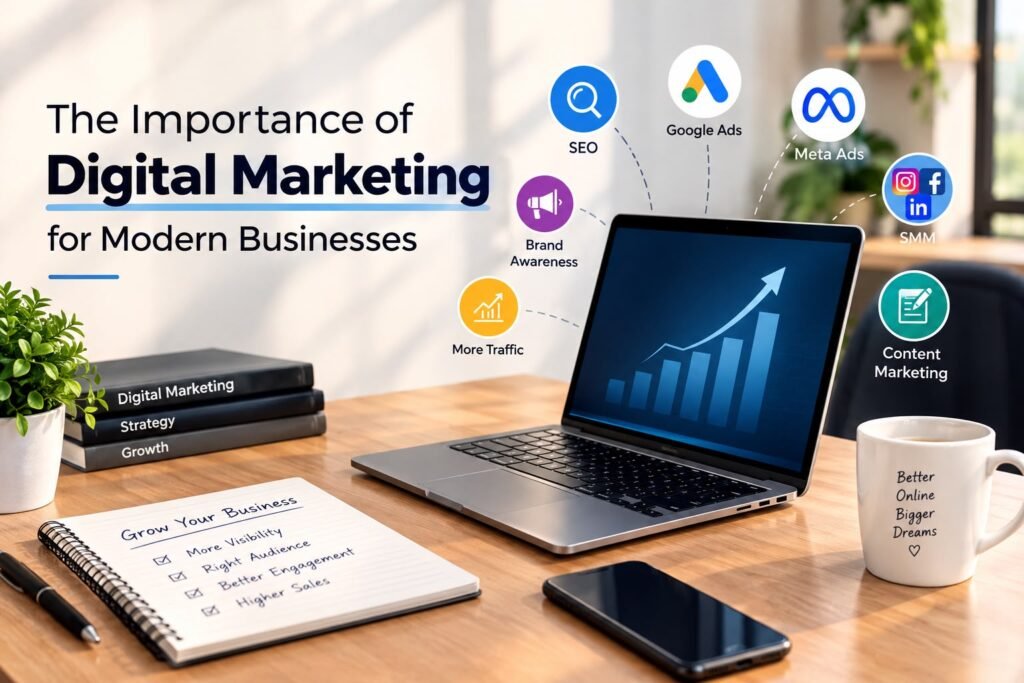
Some of the major areas of Importance of digital marketing include Search Engine Optimization (SEO), Social Media Marketing (SMM), Google Ads, Meta Ads, Content Marketing, Email Marketing, and website marketing.
Each method has a different purpose. SEO helps a website appear in organic search results. Social media marketing helps businesses communicate with audiences and build communities. Paid advertising allows businesses to reach specific groups of people quickly. Content marketing provides useful information that can attract and educate potential customers.
A successful Importance of digital marketing strategy usually combines several of these methods instead of depending on only one channel.
Why Importance of Digital Marketing ?
One of the biggest reasons Importance of digital marketing is important is the amount of time people spend online. Customers often search online before making a purchasing decision. They may search for a product on Google, visit a company’s website, check its Instagram or Facebook page, watch videos, read reviews, and compare competitors.
This means that a business needs to be visible where its potential customers are spending their time.
For example, imagine a person wants to find a digital marketing agency. Instead of asking people around them, they may search Google for digital marketing services, check websites, view social media profiles, and compare different service providers. If a business has no online presence, it may never become part of that customer’s consideration.
Importance of Digital marketing helps businesses become visible during these important moments.
-
- Reaching a Wider Audience
Traditional marketing can sometimes be limited by location and distribution. Digital marketing allows businesses to reach people beyond their immediate geographical area.
A small business can promote its products to customers in another city, state, or even another country, depending on its business model and delivery capabilities.
Social media platforms and search engines provide businesses with access to large audiences. With the right strategy, even a relatively small brand can attract attention and build an audience online.
This wider reach is particularly valuable for businesses that want to expand their customer base.
-
- Targeting the Right Audience
Another major advantage of digital marketing is audience targeting.
Traditional advertising may show an advertisement to a large group of people, even if many of them are not interested in the product. Digital marketing platforms allow businesses to define and target specific audiences based on factors such as interests, demographics, online behavior, location, and search intent.
For example, a business selling professional courses can create campaigns aimed at people interested in education, career development, or specific skills.
Targeting the right audience can reduce wasted marketing efforts and help businesses communicate with people who are more likely to become customers.
-
- Building Brand Awareness
Brand awareness is an important part of business growth. Customers are more likely to consider a brand that they recognize and remember.
Importance of Digital marketing provides many opportunities to increase brand visibility. Businesses can consistently share valuable content through social media, publish useful articles, appear in search results, run online advertisements, and communicate with customers.
For example, a company that regularly publishes educational content about its industry can gradually become familiar to its target audience. Even if a person does not purchase immediately, repeated exposure can increase brand recognition and trust.
Consistency is therefore an important part of digital branding.
-
- Improving Customer Engagement
Importance of Digital marketing is not only about advertising products. It is also about creating communication between businesses and customers.
Social media platforms allow customers to comment, ask questions, send messages, share posts, and provide feedback. Businesses can respond directly and create meaningful interactions.
This two-way communication can make customers feel more connected to a brand.
For example, a restaurant can use Instagram to share new dishes, answer customer questions, collect feedback, and announce special offers. A service-based business can use LinkedIn to share industry insights and communicate with potential clients.
Strong customer engagement can contribute to customer loyalty and long-term relationships.
-
- The Role of Search Engine Optimization
Search Engine Optimization, commonly known as SEO, is one of the most important components of digital marketing.
SEO involves improving a website and its content so that it has a better opportunity to appear in organic search engine results for relevant searches.
When people need information, products, or services, they frequently use search engines. Appearing prominently for relevant searches can bring valuable traffic to a website.
For example, if someone searches for “digital marketing services for small businesses,” a company offering those services would benefit from appearing in relevant search results.
SEO generally requires consistent effort. It may involve keyword research, useful content, technical improvements, website optimization, internal linking, and building authority.
Unlike paid advertising, organic SEO traffic does not require paying for every individual click, although effective SEO still requires time, knowledge, tools, and ongoing work.
-
- The Power of Social Media Marketing
Social media has become an important communication channel for businesses.
Platforms such as Instagram, Facebook, LinkedIn, YouTube, and other social networks allow businesses to showcase their products, educate customers, share updates, build communities, and communicate directly with their audience.
Social media marketing can also help businesses understand their audience. By analyzing engagement, comments, shares, views, and other performance indicators, businesses can learn what type of content their audience prefers.
For example, a fashion business might discover that short product videos receive more engagement than static images. It can then adjust its content strategy accordingly.
Social media is therefore not simply a platform for posting advertisements. It can become a valuable part of a company’s overall marketing and communication strategy.
-
- Google Ads and Paid Advertising
Organic marketing strategies can take time to produce results. Paid advertising provides another way for businesses to reach potential customers.
Google Ads allows businesses to advertise when people are searching for relevant products or services. This can be particularly useful because search-based advertising can reach users who already have a specific need or intention.
For example, someone searching for “website design services near me” may already be interested in hiring a service provider. A relevant advertisement can help a business appear at that moment.
Paid advertising can also be used to promote specific offers, generate leads, increase website traffic, or support product launches.
However, successful advertising requires proper planning, audience targeting, compelling ad copy, suitable landing pages, budget management, and continuous performance analysis.
-
- Meta Ads and Social Advertising
Meta advertising, including advertising across platforms such as Facebook and Instagram, provides businesses with opportunities to reach targeted audiences.
These platforms can be useful for businesses that want to create awareness, generate leads, promote products, or drive website traffic.
Visual content is especially important for social advertising. Attractive images, videos, clear messaging, and strong calls to action can influence how people respond to an advertisement.
Businesses should not simply spend money on advertisements without a strategy. They need to understand their target audience, define their objective, create suitable creatives, test different approaches, and monitor performance.
-
- Content Marketing Builds Trust
Content marketing focuses on creating and distributing useful, relevant, and valuable content for a target audience.
This content can include blog articles, videos, social media posts, guides, case studies, infographics, and educational resources.
The purpose is not always to make an immediate sale. Good content can educate potential customers and help establish a business as knowledgeable and trustworthy.
For example, a digital marketing professional could publish articles explaining SEO basics, social media strategies, or online advertising. People searching for this information may discover the content and eventually become interested in the services offered.
Content marketing can therefore support both brand awareness and customer acquisition.
-
- Measuring Marketing Performance
One of the strongest advantages of digital marketing is measurability.
Businesses can track various performance indicators, such as website traffic, impressions, clicks, engagement, leads, conversions, and advertising performance.
This data helps marketers understand which strategies are producing results.
For example, if a business spends money on two advertising campaigns and one generates significantly more qualified leads, the business can analyze the difference and use those insights to improve future campaigns.
This ability to measure and optimize marketing activities makes digital marketing more data-driven than many traditional marketing methods.
-
- Cost-Effective Marketing Opportunities
Digital marketing can provide cost-effective opportunities, especially for small and growing businesses.
A business does not necessarily need a huge marketing budget to begin building an online presence. It can start with a professional website, useful content, organic social media activity, and carefully planned advertising campaigns.
The key is not simply spending less money. It is using the available budget efficiently.
Businesses can start with a specific audience and objective, measure the results, and gradually increase investment in strategies that perform well.
This flexibility makes digital marketing accessible to businesses of different sizes.
-
- Helping Small Businesses Compete
Digital marketing can reduce some of the barriers between small businesses and larger companies.
A small business with a professional website, strong social media presence, valuable content, and effective advertising can attract attention even when competing with established brands.
Customers often care about factors such as quality, reviews, communication, expertise, and value—not only company size.
A small business that understands its audience and communicates effectively online can build a strong reputation over time.
-
- Creating a Strong Online Presence
A strong online presence is now an important part of business credibility.
When customers search for a business and find a professional website, active social media profiles, useful content, and positive reviews, they may feel more confident about the brand.
On the other hand, an outdated website, inactive social media account, or lack of online information can create uncertainty.
A professional digital presence should therefore communicate who the business is, what it offers, who it serves, and why customers should choose it.
-
- Personalization and Customer Experience
Digital marketing also makes personalized communication possible.
Businesses can create different messages for different customer groups based on their interests, behavior, location, or stage in the buying journey.
For example, someone visiting a product page may receive information about that product later, while an existing customer may receive content designed to encourage repeat purchases.
Personalization can make marketing communication more relevant and improve the overall customer experience.
Common Digital Marketing Mistakes
Although digital marketing provides many opportunities, businesses can make mistakes when they do not have a clear strategy.
One common mistake is trying to be active on every platform without understanding where the target audience actually spends time.
Another mistake is focusing only on selling instead of providing useful content. Audiences may lose interest if every post is purely promotional.
Businesses may also fail by ignoring analytics, using inconsistent branding, targeting the wrong audience, or expecting immediate results from strategies such as SEO and content marketing.
Successful digital marketing requires patience, testing, learning, and continuous improvement.
How Businesses Can Build an Effective Digital Marketing Strategy
An effective strategy begins with clear goals.
A business should first determine what it wants to achieve. The goal could be increasing brand awareness, generating leads, increasing online sales, attracting website visitors, or improving customer engagement.
Next, the business should identify its target audience. Understanding customer needs, problems, interests, and behavior helps create more relevant marketing campaigns.
The next step is selecting the right digital channels. A business does not need to use every platform. It should focus on channels that support its goals and reach its audience.
Content should then be planned around customer needs. Paid advertising can be used to accelerate reach, while SEO and content marketing can support long-term visibility.
Finally, performance should be measured regularly. Businesses should identify what is working, what is not working, and what needs to change.
The Future of Digital Marketing
Digital marketing will continue to evolve as technology and consumer behavior change.
Artificial intelligence, automation, short-form video, personalized content, voice search, data analytics, and new digital platforms are influencing the way businesses communicate with customers.
However, technology alone will not guarantee success. Businesses still need strong strategies, valuable content, customer understanding, creativity, and ethical marketing practices.
The businesses that adapt to changing customer expectations and continuously improve their digital strategies are more likely to remain competitive.
Importance of Digital Marketing
Conclusion
Digital marketing has become an essential part of modern business growth. It provides businesses with opportunities to reach wider audiences, target specific customers, build brand awareness, engage with customers, generate leads, and increase sales.
SEO can help businesses gain long-term organic visibility. Social media marketing can create engagement and build communities. Google Ads and Meta Ads can provide targeted paid reach. Content marketing can educate customers and establish credibility. Together, these strategies can create a strong digital marketing ecosystem.
However, digital marketing is not about simply being present online. Successful marketing requires a clear strategy, consistent execution, audience understanding, creative communication, and continuous measurement.
Importance of Digital Marketing For modern businesses, having a strong digital presence is no longer just an advantage—it is an important part of staying visible, competitive, and connected in an increasingly digital world.
Importance of Digital Marketing Businesses that start investing in digital marketing today can build stronger relationships with their audiences, create sustainable growth opportunities, and prepare themselves for the future of business.