
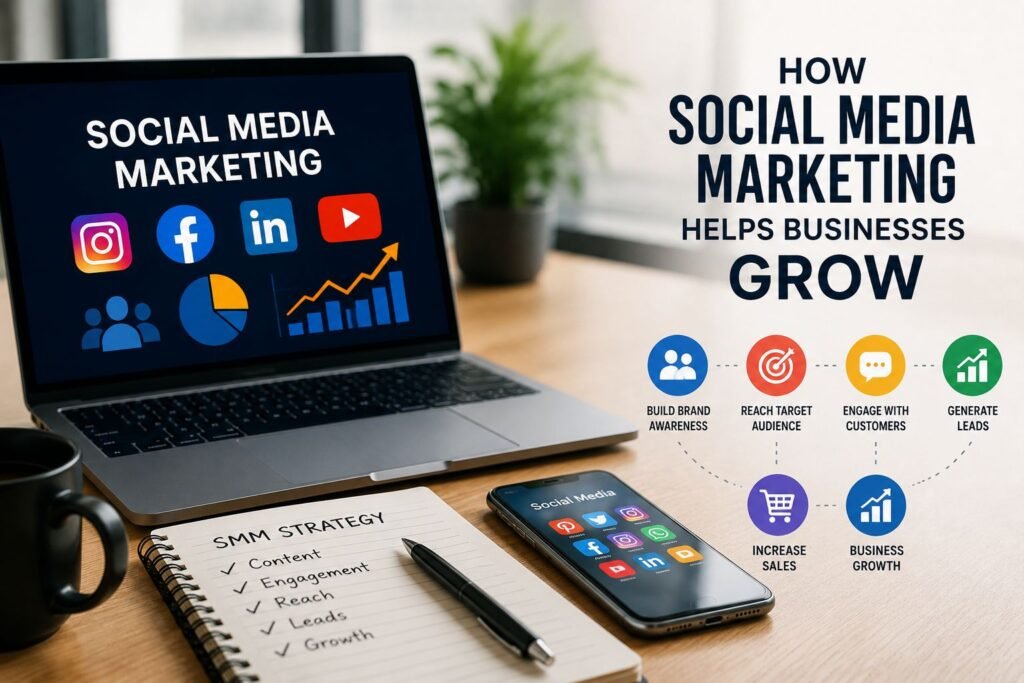
Introduction
Social Media Marketing has become one of the most powerful tools for modern businesses. Platforms such as Instagram, Facebook, LinkedIn, YouTube, and other social networks have changed the way businesses communicate with customers. What started mainly as a way for people to connect and share content has now become an important part of business marketing, branding, customer service, and sales.
Today, customers often discover brands through social media before visiting a website or making a purchase. They may watch a product video, read comments, check customer reviews, explore a company’s profile, or send a direct message before deciding whether to buy. This makes social media an important part of the customer journey.
Social Media Marketing, commonly called SMM, is the process of using social media platforms to promote a business, communicate with its target audience, build brand awareness, generate leads, increase website traffic, and support sales.
However, successful social media marketing is more than simply posting pictures every day. Businesses need a clear strategy, relevant content, consistent communication, audience understanding, and regular performance analysis.
When used effectively, social media can help businesses build strong relationships with customers and create long-term growth opportunities.
What Is Social Media Marketing?
Social Media Marketing is a digital marketing method that uses social media platforms to promote products, services, brands, or businesses.
It includes activities such as creating content, publishing posts, producing videos, responding to comments, communicating through direct messages, running advertisements, collaborating with creators, and analyzing performance.
Social media marketing can be divided into two major areas: organic social media marketing and paid social media marketing.
Organic marketing focuses on content and engagement without directly paying for advertising. Paid social media marketing involves running advertisements to reach specific audiences.
A strong strategy often combines both approaches.
Why Social Media Marketing Is Important for Businesses
The importance of social media comes from the large amount of time people spend on digital platforms.
Customers use social media not only for entertainment but also to discover businesses, learn about products, research services, follow brands, and make purchasing decisions.
If a business does not have a strong social media presence, it may miss opportunities to connect with potential customers.
Social media gives businesses a platform to communicate directly with their audience and present their brand in a more personal and engaging way.
Social Media Marketing
-
- Building Brand Awareness
One of the biggest benefits of social media marketing is increased brand awareness.
A business can consistently share its products, services, values, expertise, and visual identity with its target audience.
For example, a skincare brand can share educational posts about skincare routines, product demonstrations, customer experiences, and useful tips. Over time, people may become familiar with the brand even before they are ready to purchase.
Consistent exposure helps businesses remain recognizable.
Brand awareness is particularly important for new businesses because customers cannot choose a brand they do not know.
-
- Reaching the Right Audience
Social media platforms provide businesses with opportunities to reach specific audiences.
Businesses can create content based on their target customer’s interests, needs, age group, location, profession, lifestyle, and online behavior.
Paid social media advertising provides even more targeting possibilities.
For example, a business selling professional digital marketing courses could create campaigns aimed at people interested in digital marketing, business, entrepreneurship, education, or career development.
Reaching the right people is more valuable than simply reaching a large number of people.
A smaller audience that is genuinely interested in a business can often be more valuable than a large audience with no interest in its products or services.
-
- Increasing Customer Engagement
Social media is different from many traditional marketing channels because it allows two-way communication.
Businesses can communicate directly with customers through comments, direct messages, polls, questions, live sessions, and other interactive content.
Customers can also provide feedback and ask questions.
For example, a restaurant can ask its followers which new dish they would like to see on the menu. A clothing brand can use polls to understand customer preferences about colors or styles.
This interaction makes customers feel involved and can strengthen their connection with the brand.
-
- Building Trust and Credibility
Customers are more likely to trust businesses that communicate clearly and consistently.
A professional social media presence can demonstrate a company’s expertise, products, customer experiences, and personality.
Businesses can share educational content, behind-the-scenes activities, customer testimonials, case studies, team introductions, and useful information.
For service-based businesses, educational content can be particularly valuable.
For example, a digital marketer can share practical SEO tips, social media strategies, advertising insights, and content marketing ideas. This type of content can demonstrate knowledge and build credibility among potential clients.
-
- Generating Leads
Social media can also become an effective lead generation channel.
Businesses can encourage interested users to contact them, visit their website, sign up for a service, download a resource, or fill out a form.
For example, a digital marketing agency could publish a post explaining common advertising mistakes and invite interested business owners to contact the company for more information.
Paid campaigns can also be designed specifically for lead generation.
The important point is that businesses should make the next step clear. A strong call to action can guide interested users toward taking action.
Examples include:
-
- Contact us today.
-
- Visit our website.
-
- Book a consultation.
-
- Learn more.
-
- Send us a message.
-
- Get started.
-
- Supporting Sales
Social media can directly and indirectly contribute to sales.
Businesses can showcase products, demonstrate how they work, answer customer questions, provide offers, and guide users toward purchase.
Visual content is particularly effective for products that depend on appearance.
For example, a fashion brand can use high-quality images and videos to demonstrate products. A restaurant can use attractive food photography and short videos to encourage customers to place orders.
However, businesses should avoid making every social media post a direct sales pitch.
A healthy content strategy combines promotional content with educational, entertaining, and engaging content.
-
- The Importance of Content Strategy
A successful social media presence requires a content strategy.
Instead of posting random content, businesses should decide what they want to communicate and why.
A content strategy can include different content categories such as:
Educational content: Tips, tutorials, guides, and industry information.
Promotional content: Products, services, offers, and announcements.
Engagement content: Questions, polls, quizzes, and interactive posts.
Behind-the-scenes content: Team activities, processes, and company culture.
Social proof: Reviews, testimonials, customer stories, and results.
Using different content types keeps the social media presence interesting and helps businesses achieve different marketing objectives.
-
- Choosing the Right Social Media Platform
Businesses do not necessarily need to be active on every social media platform.
The right platform depends on the target audience, business type, content format, and marketing objectives.
Instagram is highly visual and can be useful for brands that depend on images, short-form videos, lifestyle content, and visual storytelling.
Businesses can use posts, Stories, Reels, and other formats to communicate with their audience.
Facebook can be useful for businesses that want to build communities, share different types of content, communicate with customers, and run advertising campaigns.
It can also be valuable for local businesses and businesses targeting broader demographics.
LinkedIn is particularly useful for professional networking, B2B marketing, personal branding, recruitment, and industry-related content.
Businesses can share professional insights, company updates, case studies, and educational content.
YouTube
YouTube is useful for long-form and short-form video content.
Businesses can create tutorials, product demonstrations, educational videos, reviews, interviews, and other informative content.
The goal should not be to use every platform. The goal should be to identify where the target audience is most active and create content that fits that platform.
-
- Organic Social Media Marketing
Organic social media marketing involves building an audience without paying directly for advertising distribution.
It includes regular posts, videos, Stories, engagement, community building, and conversations.
Organic marketing can be valuable for building long-term relationships.
However, organic reach can vary depending on the platform, content quality, audience behavior, and algorithm changes.
Businesses should therefore focus on creating content that people genuinely find useful or interesting.
-
- Paid Social Media Marketing
Paid social media marketing allows businesses to pay platforms to distribute advertisements to selected audiences.
Platforms such as Facebook and Instagram provide businesses with advertising tools that can support different objectives.
A business may run campaigns to increase awareness, generate leads, drive website traffic, promote products, or encourage conversions.
Paid advertising can provide faster reach compared with relying entirely on organic content.
However, successful advertising requires more than simply boosting a post. Businesses need clear objectives, appropriate targeting, strong creative content, persuasive messaging, suitable landing pages, and performance tracking.
-
- Creating High-Quality Visual Content
Social media is highly visual, so content quality matters.
Images, videos, graphics, typography, and branding should be consistent with the business identity.
However, high-quality does not necessarily mean complicated.
A simple, clear, useful video can perform better than an expensive production if it communicates a message that the audience actually cares about.
Businesses should focus on clarity, relevance, authenticity, and value.
-
- Using Short-Form Video
Short-form video has become an important content format across many social platforms.
Short videos can quickly communicate ideas, demonstrate products, answer questions, provide tips, or tell stories.
For example, a digital marketing professional could create short videos explaining one SEO tip at a time.
The first few seconds are particularly important because users often scroll quickly through their feeds.
A strong opening, clear message, useful information, and simple call to action can make short-form videos more effective.
-
- Customer Service Through Social Media
Social media can also function as a customer service channel.
Customers may contact businesses through comments or direct messages with questions about products, prices, availability, delivery, or services.
Fast and professional responses can improve customer satisfaction.
Businesses should establish clear communication guidelines and ensure that customers receive accurate information.
Ignoring messages or responding unprofessionally can negatively affect the brand’s reputation.
-
- Using Analytics to Improve Performance
One of the most important parts of social media marketing is measuring performance.
Businesses should not judge success only by the number of followers.
Important metrics can include:
-
- Reach
-
- Impressions
-
- Engagement
-
- Video views
-
- Website clicks
-
- Leads
-
- Conversions
-
- Follower growth
-
- Cost per result for paid campaigns
These metrics help businesses understand what content is working.
For example, if educational videos consistently receive strong engagement while certain promotional posts receive very little interaction, the business may want to adjust its content strategy.
Analytics turn social media marketing from guesswork into a more data-driven process.
-
- Understanding the Target Audience
A successful social media strategy begins with understanding the audience.
Businesses should identify who their ideal customers are and what problems they are trying to solve.
Questions such as these can help:
Who is the target customer?
What are their needs?
What challenges do they face?
What type of content do they consume?
Which social platforms do they use?
What factors influence their purchasing decisions?
The better a business understands its audience, the easier it becomes to create relevant content.
Common Social Media Marketing Mistakes
Many businesses struggle with social media because they focus on posting frequently instead of posting strategically.
One common mistake is inconsistent branding. Different fonts, visuals, messages, and tones can make a brand appear unprofessional.
Another mistake is posting only promotional content. Customers do not want to see advertisements all the time.
Ignoring comments and messages is another problem. Social media is built around communication, so businesses should actively engage with their audience.
Businesses should also avoid buying followers. Fake followers may increase a follower count but usually do not provide meaningful engagement, leads, or sales.
Finally, businesses should avoid copying competitors without developing their own identity.
How to Create an Effective Social Media Strategy
A strong strategy can be created through several steps.
Step 1: Set Clear Goals
Decide what the business wants to achieve.
The goal may be brand awareness, engagement, leads, website traffic, or sales.
Step 2: Identify the Target Audience
Understand who the business wants to reach and what matters to them.
Step 3: Choose the Right Platforms
Focus on platforms where the target audience is active.
Step 4: Create a Content Plan
Decide what topics, formats, and content categories will be published.
Step 5: Maintain Consistency
Create and publish content consistently while maintaining a recognizable brand identity.
Step 6: Engage With the Audience
Respond to comments, answer questions, and participate in meaningful conversations.
Step 7: Analyze Performance
Review analytics regularly and identify what is working.
Step 8: Improve the Strategy
Use the data to adjust content, targeting, posting methods, and advertising campaigns.
Social Media Marketing for Small Businesses
Social media can be especially valuable for small businesses because it provides opportunities to build visibility without requiring the same resources as traditional large-scale advertising.
A small business can showcase its products, introduce its team, share customer experiences, educate its audience, and communicate directly with potential customers.
For example, a local bakery can use Instagram to showcase new products, share behind-the-scenes videos, announce offers, and encourage customers to visit the store.
The key is consistency and authenticity rather than simply trying to imitate large brands.
The Future of Social Media Marketing
Social media marketing will continue to evolve as technology and user behavior change.
Artificial intelligence, automation, personalized content, short-form video, creator collaborations, social commerce, and data-driven advertising are likely to continue influencing digital marketing.
At the same time, customers will continue to value authenticity and meaningful communication.
Businesses that understand their audience, adapt to new technologies, experiment with different content formats, and maintain a strong brand identity will be better positioned to succeed.
Conclusion
Social media marketing has become an important part of modern business growth. It provides businesses with opportunities to increase brand awareness, reach targeted audiences, build relationships, generate leads, support sales, and communicate directly with customers.
However, successful social media marketing is not simply about posting regularly. It requires a clear strategy, quality content, audience understanding, consistent branding, active engagement, and continuous performance analysis.
Businesses should focus on providing value rather than constantly trying to sell. Educational content, engaging videos, customer stories, useful information, and authentic communication can help create stronger connections with audiences.
Organic social media can help businesses build communities over time, while paid advertising can provide targeted reach and support specific business objectives. When these approaches are combined with other digital marketing strategies such as SEO, content marketing, and search advertising, they can create a powerful overall marketing system.
Ultimately, social media is not just a place for businesses to promote products. It is a platform for building relationships, communicating ideas, demonstrating expertise, understanding customers, and creating a recognizable brand.
Businesses that use social media strategically and consistently can turn online attention into meaningful relationships and long-term growth.