
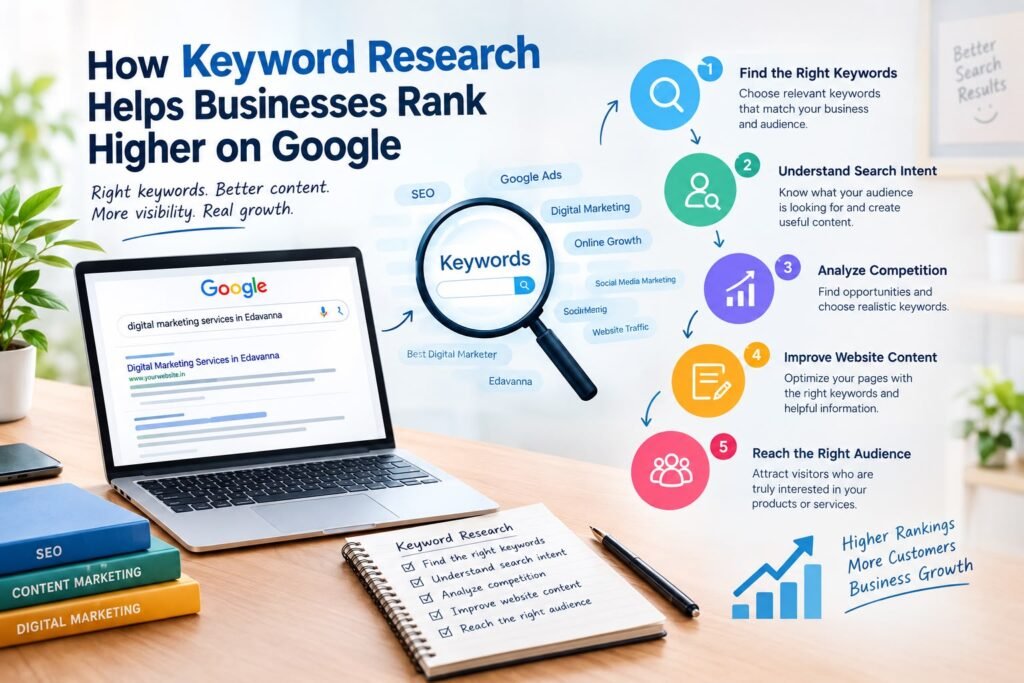
How Keyword Research Helps Businesses Rank Higher on Google is an important topic for businesses that want to improve their online visibility. Keyword research helps businesses understand what people search for, identify relevant keywords, and create useful website content that attracts the right audience.
In today’s digital world, having a website is not enough to grow a business online. Your website needs to reach the right audience at the right time. One of the most important steps in improving your website’s visibility on search engines is keyword research. It helps businesses understand what people search for on Google and how to create content that meets their needs.
Keyword research is an essential part of Search Engine Optimization (SEO). It allows businesses to identify relevant search terms, understand customer interests, analyze competition, and improve website content. When done correctly, keyword research can help attract relevant visitors, improve online visibility, and create opportunities for business growth.
For small businesses, freelancers, and service providers, keyword research can be particularly valuable. Instead of publishing content without a clear direction, businesses can develop an SEO strategy based on what their potential customers are searching for.
In this article, we will explore how keyword research helps businesses improve their Google rankings and build a stronger online presence.
What Is Keyword Research?
How Keyword Research Helps Businesses Rank Higher on Google
Keyword research is the process of discovering and analyzing the words and phrases people enter into search engines when looking for information, products, or services.
For example, someone searching for digital marketing services might use phrases such as:
-
- Best digital marketer in Edavanna
-
- Digital marketing services near me
-
- SEO services for small businesses
-
- Google Ads expert in Malappuram
-
- Social media marketing services
These search terms provide valuable information about what potential customers want to find.
By identifying relevant keywords, businesses can create website pages, blog posts, service descriptions, and other content that answers users’ questions.
Keyword research isn’t just about finding popular search terms. It is about understanding the relationship between a user’s search, their needs, and the information your website provides.
A successful keyword strategy focuses on relevance, search intent, competition, and the overall value a keyword can bring to a business. How Keyword Research Helps Businesses Rank Higher on Google.
-
- Finding the Right Keywords
Finding the right keywords is the first step in building an effective SEO strategy. Not every keyword is suitable for every business. The best keywords are closely related to the services you offer and the information your target audience needs.
For example, a local digital marketer should focus on keywords related to SEO, Google Ads, social media marketing, and digital marketing services in the relevant service area.
Understand Your Business and Services,. How Keyword Research Helps Businesses Rank Higher on Google.
Start by identifying the main products or services your business offers. Think about the problems you solve and the words customers might use when searching for your services.
If you provide digital marketing services, your keyword ideas might include:
-
- Digital marketing services
-
- Search engine optimization services
-
- Google Ads management
-
- Social media marketing
-
- Website SEO services
-
- Digital marketing for small businesses
These keywords provide a starting point for further research.
Use Keyword Research Tools
Keyword research tools can help you discover new keyword ideas and understand their estimated search demand and competition.
Useful tools include:
-
- Google Keyword Planner
-
- Google Trends
-
- Google Search Console
-
- Ahrefs
-
- Semrush
Each tool provides different insights. For example, Google Keyword Planner can help you explore keyword ideas and estimated search volumes. Google Trends can show how interest in a topic changes over time. Google Search Console can reveal the queries for which your existing website receives impressions and clicks.
Some tools require paid subscriptions, while others offer free features or access under certain conditions.
Focus on Relevant Keywords,. How Keyword Research Helps Businesses Rank Higher on Google.
A keyword may have a high search volume, but that does not automatically make it the best choice for your website.
Imagine that you provide digital marketing services in Edavanna. A broad keyword such as “digital marketing” may attract a wide range of visitors, including students, job seekers, and people looking for general information.
A more specific phrase, such as “digital marketing services in Edavanna,” may be more closely related to your business goals.
Choose keywords based on their relevance to your services, your audience, and the purpose of each website page.
How Keyword Research Helps Businesses Rank Higher on Google.
-
- Understanding Search Intent
Search intent refers to the reason behind a user’s search query. Understanding search intent is important because Google aims to provide results that satisfy what users are looking for.
Even when two keywords contain similar words, the people searching for them may have different goals.
There are four common types of search intent.
Informational Intent
Users with informational intent want to learn something or find an answer to a question.
Examples include:
-
- What is SEO?
-
- How does keyword research work?
-
- How can I improve my website ranking?
-
- What are the benefits of digital marketing?
Blog posts, tutorials, guides, and educational articles are suitable for these searches.
For example, an article explaining how keyword research works can attract people who want to understand SEO before investing in digital marketing services.
Navigational Intent, How Keyword Research Helps Businesses Rank Higher on Google.
Users with navigational intent want to find a particular website, brand, or online destination.
Examples include searches for a business name, a website name, or a specific online service.
For these searches, having clear branding, accessible website pages, and consistent business information can help users find the intended destination.
Commercial Investigation, How Keyword Research Helps Businesses Rank Higher on Google.
Users with commercial investigation intent are researching different options before making a decision. How Keyword Research Helps Businesses Rank Higher on Googl
Examples include:
-
- Best digital marketer in Edavanna
-
- Best SEO services for small businesses
-
- Google Ads vs SEO
-
- Digital marketing agency comparison
These searches often indicate that users are evaluating available services or comparing possible solutions.
Helpful service pages, comparison articles, case studies, and transparent explanations can support these users during their decision-making process.
Transactional Intent, How Keyword Research Helps Businesses Rank Higher on Google.
Users with transactional intent are ready to take an action, such as contacting a service provider, purchasing a product, or requesting a quotation.
Examples include:
-
- Hire an SEO expert in Edavanna
-
- Contact a digital marketer
-
- Book digital marketing consultation
A clear service page with relevant information and an easy-to-find contact option can help users take the next step.
Why Search Intent Matters. How Keyword Research Helps Businesses Rank Higher on Google.
Creating content that matches search intent makes your website more useful to visitors.
If someone searches for an educational guide but lands on a page that only promotes a service, the content may not meet their expectations. Similarly, someone looking to hire a professional may prefer a clear service page rather than a general educational article.
Before targeting a keyword, search for it on Google and review the types of pages that appear. This can help you understand what users may expect from the results.
-
- Analyzing Keyword Competition
Keyword competition refers to how challenging it may be to gain visibility for a particular search term.
Some keywords are targeted by many established websites with extensive content and strong backlink profiles. Others are more specific and may have fewer competing pages.
Understanding competition helps businesses choose realistic keywords for their SEO strategies.
Analyze the Existing Search Results. How Keyword Research Helps Businesses Rank Higher on Google.
Search for your target keyword on Google and review the pages that appear.
Consider these questions:
-
- Are the top results published by established businesses?
-
- Do the pages provide detailed and useful information?
-
- Are local businesses appearing in the results?
-
- Does the content answer the user’s question?
-
- Could your website provide something more relevant or helpful?
This analysis can help you identify opportunities to improve your content.
However, search results alone cannot reveal every ranking factor. Google’s ranking systems consider many signals, so a quick review should be treated as a starting point rather than a complete competition analysis.
Explore Long-Tail Keywords. How Keyword Research Helps Businesses Rank Higher on Google.
Long-tail keywords are specific search phrases that often express a clearer need.
For example:
-
- Digital marketing services for small businesses in Edavanna
-
- How to improve local SEO for a small business
-
- Affordable Google Ads management for local businesses
These phrases may have lower search demand than broad keywords, but they can be more closely aligned with a particular audience or need.
Long-tail keywords are not automatically easy to rank for. Their value depends on factors such as relevance, competition, search intent, and the quality of the content you create.
Evaluate Your Website’s Current Performance. How Keyword Research Helps Businesses Rank Higher on Google.
Google Search Console is useful for understanding how your website performs for different queries.
You can review:
-
- Search queries generating impressions
-
- Queries receiving clicks
-
- Average search position
-
- Click-through rate
-
- Pages appearing in Google Search
For example, if a page receives impressions for a relevant keyword but few clicks, you can review its title and description to see whether they clearly communicate the page’s value.
If the page receives very few impressions, investigate whether it is indexed, relevant to the intended search, and sufficiently useful.
By analyzing actual performance data, you can make more informed decisions about which keywords to target next.
-
- Improving Website Content
Once you identify suitable keywords, the next step is to create or improve content that genuinely helps users.
Keyword research provides direction, but useful content is what gives visitors a reason to stay, learn, and take action.
Create Helpful and Relevant Content
Each website page should have a clear purpose.
A service page should explain what you offer, who can benefit, and how visitors can contact you. An educational blog post should answer its main question and provide useful explanations.
For example, a blog post targeting “how keyword research helps businesses rank higher on Google” should explain keyword selection, search intent, competition, content optimization, and audience targeting.
Avoid adding unnecessary paragraphs simply to reach a particular word count. Content length should reflect the topic and the information readers need.
Optimize Page Titles. How Keyword Research Helps Businesses Rank Higher on Google.
The page title helps users understand what a page is about and can appear as the clickable headline in Google Search.
Write a unique, descriptive title that accurately represents the page.
For example:
“How Keyword Research Helps Businesses Rank Higher on Google”
This title communicates the subject clearly and includes the primary keyword naturally.
Avoid repeating the same keyword excessively or creating misleading titles to attract clicks.
Write Useful Meta Descriptions
A meta description summarizes the content of a webpage. Google may use it to generate the snippet shown in search results, although it can choose different text from the page.
For this article, a possible meta description is:
“Learn how keyword research helps businesses improve SEO, understand search intent, analyze competition, and attract relevant visitors from Google.”
A clear description can help users understand what they will find on your page.
Use Headings Properly
Headings organize information and make content easier to read.
Use an H1 heading for the main page title, then use H2 headings for major sections and H3 headings for relevant subsections.
For this article, headings such as “Finding the Right Keywords” and “Understanding Search Intent” make the content easier to navigate.
Include related terms naturally when they help describe a section. Do not force the same keyword into every heading.
Optimize Images
Images can make website content more engaging and easier to understand.
Use descriptive image filenames and meaningful alternative text for informative images.
For example, an image showing a keyword research process could use the filename:
keyword-research-seo-strategy.jpg
Its alternative text could be:
“Keyword research process for improving website SEO.”
Alternative text should describe the actual image and its purpose. It should not be filled with unrelated keywords.
Add Relevant Internal Links
Internal links connect one page of your website to another.
For example, an article about keyword research could link to a relevant SEO service page or another useful article on your website.
Internal linking helps visitors discover related information and helps search engines understand how your pages relate to one another.
Use descriptive anchor text and link only when the destination is genuinely relevant.
-
- Reaching the Right Audience
The purpose of keyword research is not simply to increase website traffic. It is to attract people who are genuinely interested in your content, products, or services.
A website may receive many visitors but generate few enquiries if its content attracts the wrong audience.
Identify Your Target Audience
Before choosing keywords, understand the people you want to reach.
Ask yourself:
-
- Who are my potential customers?
-
- What problems are they trying to solve?
-
- What services are they looking for?
-
- Which locations do I serve?
-
- What questions might they ask before contacting a business?
For a local digital marketer, the target audience might include small business owners, entrepreneurs, shop owners, and service providers who want to improve their online visibility.
Understanding these needs helps you select more relevant keywords.
Use Location-Based Keywords Naturally
Local keywords can help businesses communicate where they provide their services.
Examples include:
-
- Digital marketer in Edavanna
-
- SEO services in Edavanna
-
- Digital marketing services in Malappuram
Use location-based phrases only where they accurately describe your business and service area.
For a local service provider, relevant location information can appear naturally in service pages, contact details, business information, and useful local content.
However, adding a location to a keyword does not guarantee local rankings. Google’s local results can depend on relevance, distance, prominence, and other factors.
Answer Your Audience’s Questions
Think about the questions potential customers ask before choosing a service.
For example:
-
- Why does my website not appear on Google?
-
- How can SEO help my small business?
-
- Should I choose Google Ads or SEO?
-
- How can I attract more customers through my website?
Creating helpful content around these questions can introduce your website to people who are researching solutions.
When the content matches their needs, visitors may explore your other pages or contact you for additional information.
Measure the Quality of Your Traffic
Website traffic alone does not tell the complete story.
Use available analytics tools to understand how visitors interact with your website.
You can monitor:
-
- Organic search visits
-
- Relevant page views
-
- Engagement with important pages
-
- Contact form submissions
-
- Calls or other enquiries, where tracking is available
These measurements help you understand whether your keyword strategy is attracting the right audience and supporting your business objectives.
-
- Common Keyword Research Mistakes to Avoid
Even a well-planned SEO strategy can become less effective when keyword research is approached incorrectly.
Keyword Stuffing
Keyword stuffing means repeating a keyword unnaturally in an attempt to influence rankings.
For example, repeatedly using “best digital marketer in Edavanna” in every paragraph can make an article difficult to read.
Instead, use the main keyword where it fits naturally and include related phrases when they improve clarity.
Targeting Only High-Volume Keywords
Keywords with high estimated search volumes can be attractive, but they may not be the most relevant or achievable options for every website.
Consider relevance, search intent, competition, and the needs of your target audience rather than relying on search volume alone.
Ignoring Search Intent
A keyword can attract visitors without meeting their expectations if the content does not answer their query.
Always consider what the user wants to accomplish before deciding which type of page to create.
Publishing Similar Pages
Creating multiple pages that target nearly identical search intent can make it harder to maintain a clear purpose for each page.
Before creating a new article, review your existing website content. If a relevant page already exists, consider improving it instead of publishing another page covering the same topic.
Forgetting to Update Content
Search trends, customer needs, and business services can change over time.
Review important pages periodically and update outdated information, examples, links, and recommendations when necessary.
Do not change content simply to make frequent edits. Make improvements when they provide real value to readers.
-
- How to Build an Effective Keyword Research Strategy
Businesses can follow a simple process to make keyword research more organized and effective.
How Keyword Research Helps Businesses Rank Higher on Google.
Step 1: Define Your Goal
Decide whether you want to increase relevant traffic, attract local customers, generate enquiries, or improve visibility for a particular service.
Step 2: Create a List of Keyword Ideas
Brainstorm terms related to your services, products, audience, and customers’ questions.
Step 3: Research Search Demand
Use keyword research tools to explore search volume estimates, related terms, and changes in interest.
Remember that search volume estimates are not exact predictions of website traffic.
Step 4: Understand Search Intent
Review the search results and identify whether users want information, comparisons, a particular website, or a service.
Step 5: Analyze Competition
Examine competing pages and identify opportunities to provide more relevant, helpful, or complete information.
Step 6: Assign Keywords to Appropriate Pages
Choose a primary topic for each important page. Use related keywords naturally without forcing every phrase onto the same page.
Step 7: Publish Useful Content
Create content that answers the user’s question and provides a clear next step where appropriate.
Step 8: Monitor and Improve
Use Google Search Console and suitable analytics tools to assess performance. Improve pages based on evidence rather than making changes solely because rankings fluctuate.
SEO takes time, and results are not guaranteed. Consistent, thoughtful improvements can help businesses build a stronger search presence over time.
Conclusion
How Keyword Research Helps Businesses Rank Higher on Google.
Keyword research is an important part of building a successful SEO strategy. It helps businesses discover what people are searching for, understand their needs, evaluate competition, improve website content, and reach a more relevant audience.
By selecting appropriate keywords, matching content to search intent, optimizing website pages, and monitoring performance, businesses can make more informed decisions about their online marketing efforts.
For small businesses and local service providers, a focused keyword strategy can help them communicate their services to the right audience and create growth opportunities.
Remember that keyword research alone does not guarantee first-page rankings. Search visibility also depends on content quality, technical SEO, website usability, competition, and other factors.
Start by understanding your audience, researching relevant search terms, and creating genuinely helpful content. With a consistent and user-focused approach, your website can build a stronger foundation for long-term organic growth.
Looking for Digital Marketing Support?
If you want to improve your website’s search visibility and develop a stronger online presence, explore the digital marketing resources and services available on my website.
Visit Binshiya Ak at https://binshiya.in to learn more about SEO, Google Ads, Meta Ads, social media marketing, and content marketing.