
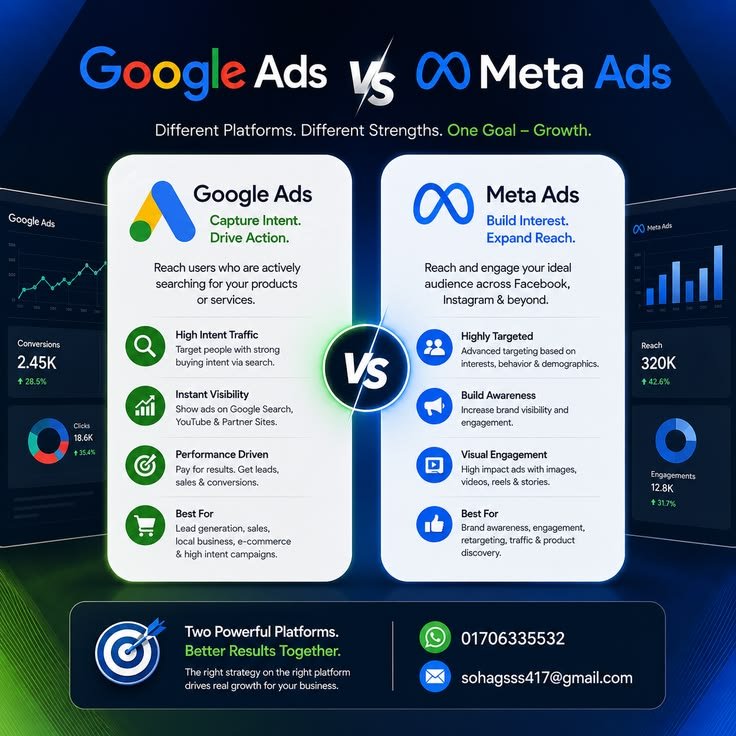
“Google Ads vs Meta Ads is an important comparison for businesses looking to reach potential customers online. Both platforms offer effective ways to promote products and services, but they work in different ways. Choosing the right advertising platform depends on your business goals, target audience, budget, and marketing strategy.”
In the world of digital marketing, paid advertising has become one of the most effective ways for businesses to reach potential customers. Instead of waiting for customers to discover a business organically, paid advertising allows brands to reach specific audiences at the right time with carefully designed campaigns.
Two of the most popular advertising platforms are Google Ads and Meta Ads. Both platforms can help businesses increase visibility, generate leads, drive website traffic, promote products, and increase sales. However, they work in very different ways.
Google Ads primarily helps businesses reach people who are actively searching for products, services, or information. Meta Ads, which includes advertising across platforms such as Facebook and Instagram, is particularly powerful for reaching people based on their interests, behaviours, demographics, and online activity.
The question is not simply whether Google Ads or Meta Ads is better. The better question is: Which platform is more suitable for your business, your audience, and your marketing objective?
Understanding the differences between these platforms can help businesses make better advertising decisions.
Google Ads vs Meta Ads
What Are Google Ads?
Google Ads is Google’s online advertising platform. Businesses can use it to display advertisements across Google’s advertising ecosystem.
One of its most popular formats is search advertising. These ads can appear when users search for specific keywords related to a product or service.
For example, imagine someone searches for:
“Best digital marketing agency near me”
A business offering digital marketing services can potentially show an advertisement to that person.
This is powerful because the user has already expressed an interest or intent through their search.
Google Ads also supports other advertising formats, including display advertising, video advertising, shopping-related campaigns, and other campaign types depending on the business objective.
What Are Meta Ads?
Meta Ads are paid advertisements provided through Meta’s advertising ecosystem, primarily including Facebook and Instagram.
Unlike search advertising, Meta Ads generally do not depend on users actively searching for a particular product.
Google Ads vs Meta Ads
Instead, businesses can reach audiences based on characteristics such as:
-
- Age
-
- Location
-
- Interests
-
- Behaviours
-
- Demographics
-
- Engagement
-
- Online activity
-
- Custom audiences
-
- Website interactions
For example, a clothing brand can show an advertisement for a new collection to people who are likely to be interested in fashion.
This makes Meta Ads particularly useful for creating awareness and generating demand.
The Biggest Difference Between Google Ads and Meta Ads
The fundamental difference can be explained simply:
Google Ads captures existing demand.
Meta Ads helps create and stimulate demand.
Consider a person who wants to buy running shoes.
If they search Google for:
“Buy running shoes online”
they already have buying intent.
A Google advertisement can appear at that moment and potentially bring that customer to a website.
Now consider someone scrolling through Instagram who is not actively searching for running shoes. They may see an attractive advertisement featuring a new pair of running shoes.
The advertisement could create interest and encourage them to explore the product.
This difference in user intent is one of the most important factors when choosing between the two platforms.
Google Ads vs Meta Ads
Google Ads: Major Advantages
-
- High Purchase Intent
One of the biggest advantages of Google Ads is search intent.
When users search for specific products or services, they often have an immediate need.
For example:
-
- “Laptop repair near me”
-
- “Best wedding photographer”
-
- “Digital marketing course”
-
- “Buy formal shoes online”
-
- “AC service near me”
These searches indicate that the person is actively looking for a solution.
Businesses can place themselves in front of potential customers at the exact moment they are searching.
Google Ads vs Meta Ads
-
- Excellent for Lead Generation
Google Ads can be highly effective for service-based businesses.
Businesses such as:
-
- Digital marketing agencies
-
- Educational institutions
-
- Real estate companies
-
- Clinics
-
- Legal services
-
- Repair services
-
- Travel companies
can use search advertising to attract people who are already looking for their services.
A well-optimised campaign can direct potential customers to a landing page, enquiry form, phone number, or contact page.
Google Ads vs Meta Ads
-
- Keyword Targeting
Keywords are an important part of Google Search campaigns.
Businesses can identify search terms that their potential customers are likely to use.
For example, a digital marketing agency might target keywords related to:
-
- Digital marketing services
-
- SEO services
-
- Google Ads management
-
- Social media marketing
-
- Content marketing
The goal is to connect relevant searches with relevant advertisements.
Google Ads vs Meta Ads
-
- Measurable Performance
Google Ads provides detailed performance data.
Businesses can monitor metrics such as:
-
- Clicks
-
- Impressions
-
- Click-through rate
-
- Cost per click
-
- Conversions
-
- Conversion rate
-
- Cost per conversion
This allows marketers to evaluate campaign performance and make data-driven decisions.
Google Ads: Limitations
Google Ads vs Meta Ads
Google Ads can be powerful, but it is not perfect for every business.
-
- Competition Can Be Expensive
Popular keywords can have high competition.
When multiple businesses compete for the same search terms, advertising costs can increase.
This means businesses need proper keyword research, campaign optimisation, and budget management.
-
- Requires Strong Search Demand
Google Ads works particularly well when people are already searching for the product or service.
But what happens when customers do not know that a particular product exists?
In such situations, Meta Ads may be more effective because it can introduce products to potential customers who are not actively searching.
-
- Requires Optimisation
Launching a campaign is only the beginning.
Marketers need to monitor:
-
- Search terms
-
- Keywords
-
- Bids
-
- Ad performance
-
- Landing pages
-
- Conversions
Regular optimisation is necessary to improve campaign efficiency.
Google Ads vs Meta Ads
Meta Ads: Major Advantages
-
- Powerful Audience Targeting
Meta’s advertising ecosystem provides marketers with various ways to define their target audience.
Businesses can create audiences based on characteristics such as interests, demographics, behaviours, and previous interactions.
For example, a skincare brand may want to reach people interested in skincare, beauty, cosmetics, and related topics.
This allows businesses to reach potential customers before they actively search for a product.
Google Ads vs Meta Ads
-
- Excellent Visual Advertising
Meta platforms are highly visual.
Businesses can use:
-
- Images
-
- Videos
-
- Reels
-
- Stories
-
- Carousels
-
- Collections
-
- Other creative formats
This is particularly useful for businesses where visual presentation matters.
Examples include:
-
- Fashion
-
- Beauty
-
- Food
-
- Travel
-
- Fitness
-
- Home décor
-
- Lifestyle products
A visually attractive advertisement can stop users while they are scrolling and encourage them to learn more.
-
- Excellent for Brand Awareness
Meta Ads can help businesses introduce their brand to new audiences.
Suppose a new clothing brand launches online.
Instead of waiting for people to search for the brand name, the company can advertise its products to people who are likely to be interested in fashion.
This can help create awareness and generate future demand.
Google Ads vs Meta Ads
-
- Retargeting Opportunities
One of the strongest features of digital advertising is the ability to reconnect with people who have already interacted with a business.
For example, someone may visit an online store and view a product without purchasing it.
Retargeting can help businesses show relevant advertisements to people who have previously interacted with their website or social media presence, subject to platform policies and available tracking capabilities.
This can help bring potential customers back into the buying journey.
Meta Ads: Limitations
-
- Lower Purchase Intent in Some Campaigns
People generally use Facebook and Instagram for social interaction, entertainment, information, and discovery.
They may not necessarily be looking to purchase something when they see an advertisement.
Therefore, converting someone who sees an advertisement while casually scrolling may require stronger creative, messaging, and follow-up.
-
- Creative Quality Matters
Meta is highly visual.
If an advertisement looks boring or irrelevant, users can quickly scroll past it.
Businesses need strong:
-
- Headlines
-
- Images
-
- Videos
-
- Hooks
-
- Captions
-
- Calls to action
Creative testing is therefore an important part of Meta advertising.
-
- Audience Fatigue
If the same audience repeatedly sees the same advertisement, performance can decline.
This is known as ad fatigue.
Businesses may need to refresh their creative, test different messages, or adjust their audience strategy.
Google Ads vs Meta Ads: A Simple Comparison
Feature Google Ads Meta Ads
Main strength Capturing search intent Creating demand
Platforms Google ecosystem Facebook & Instagram ecosystem
Targeting Keywords and audience signals Demographics, interests, behaviours and audiences
Best for High-intent searches Discovery and awareness
Creative Search text, visual and other formats Images, videos, reels, stories and more
Brand awareness Good Excellent
Lead generation Excellent for high-intent searches Excellent with strong targeting and creative
Product discovery Moderate to strong Strong
Retargeting Available Available
Visual storytelling Moderate to strong depending on format Very strong
Google Ads vs Meta Ads
Which Platform Is Better for E-Commerce?
For e-commerce businesses, both platforms can be valuable.
Meta Ads can be useful for discovering new customers and showcasing products visually.
For example, a fashion brand can use Instagram advertisements to display:
-
- New collections
-
- Product videos
-
- Styling ideas
-
- Customer content
-
- Offers
Google Ads can be valuable when customers are actively searching for specific products.
For example, someone searching for:
“Buy black formal shoes”
may already be close to making a purchase.
Therefore, e-commerce businesses can benefit from using both platforms together.
Which Platform Is Better for Local Businesses?
Local businesses can also use both platforms.
Google Ads can be especially useful for services where customers search when they have an immediate need.
Examples include:
-
- Plumbers
-
- Electricians
-
- Salons
-
- Repair services
-
- Restaurants
-
- Clinics
-
- Cleaning services
Meta Ads can be useful for building local awareness and promoting offers, events, products, and services to people in a specific geographic area.
A local restaurant, for example, could use Instagram advertisements to showcase attractive food images and special offers.
Which Platform Is Better for Personal Brands?
Personal brands can benefit significantly from Meta platforms and Google.
Instagram can help personal brands share:
-
- Reels
-
- Educational content
-
- Personal stories
-
- Expertise
-
- Achievements
-
- Behind-the-scenes content
Google Ads may be useful when a personal brand offers a specific service that people actively search for.
For example, a consultant could advertise when potential clients search for a relevant service.
However, organic content and personal branding are particularly important because trust plays a major role in personal-brand marketing.
Can You Use Google Ads and Meta Ads Together?
Yes.
In many cases, using both platforms can create a stronger overall marketing strategy.
Imagine a customer journey:
Stage 1: Discovery
A person sees a brand advertisement on Instagram.
They become aware of the brand but do not purchase immediately.
Stage 2: Research
Later, the person searches Google for the product or service.
The business appears in relevant search results through advertising.
Stage 3: Consideration
The customer visits the website and compares options.
Stage 4: Remarketing
The business can reconnect with the customer through suitable remarketing strategies.
Stage 5: Conversion
The customer eventually makes a purchase or submits an enquiry.
This shows how different platforms can work together rather than competing with each other.
How to Choose the Right Platform
Businesses should consider several factors before deciding where to invest their advertising budget.
-
- Understand Customer Behaviour
Ask:
How does my customer discover my product?
If they actively search for it, Google Ads may be a strong option.
If they discover products through social media, Meta Ads may be more suitable.
-
- Consider Your Business Type
A service business may benefit strongly from Google Search campaigns because customers often search when they need a service.
A visually driven product business may benefit greatly from Meta’s visual advertising environment.
-
- Define Your Goal
Your campaign objective matters.
If the goal is:
Brand awareness → Meta Ads can be useful.
Search-based leads → Google Ads can be useful.
Product discovery → Meta Ads can be effective.
High-intent conversions → Google Ads can be highly valuable.
Full-funnel marketing → Using both may be the strongest approach.
Budget Planning
There is no universal advertising budget that works for every business.
Budget depends on:
-
- Industry
-
- Competition
-
- Location
-
- Audience
-
- Product price
-
- Customer lifetime value
-
- Campaign objective
-
- Expected conversion rate
Instead of asking only, “How much should I spend?”, businesses should ask:
“How much can I afford to spend to acquire one customer profitably?”
This helps create a more practical advertising strategy.
Businesses should start with a realistic test budget, collect data, identify what works, and gradually scale successful campaigns.
Importance of Landing Pages
Advertising does not end when someone clicks an advertisement.
The landing page plays an important role in converting visitors.
A good landing page should generally have:
-
- A clear headline
-
- Relevant information
-
- Strong visuals
-
- Benefits of the product or service
-
- Trust signals
-
- Clear call to action
-
- Easy navigation
-
- Mobile-friendly design
If an advertisement promises one thing but the landing page provides something completely different, users may leave without converting.
Therefore, ad optimisation and landing-page optimisation should work together.
Importance of Testing
Digital advertising allows marketers to experiment.
Businesses can test different:
-
- Headlines
-
- Images
-
- Videos
-
- Audiences
-
- Keywords
-
- Offers
-
- Calls to action
-
- Landing pages
For example, a Meta campaign might test two different videos.
If one video generates more qualified leads at a lower cost, the marketer can allocate more budget toward the stronger creative.
Similarly, Google Ads campaigns can test different ad messages and keyword strategies.
Testing turns advertising from guesswork into a data-driven process.
Common Mistakes in Paid Advertising
Choosing a Platform Without Research
Businesses sometimes select a platform simply because it is popular.
The better approach is to understand where the target audience is and how they make purchasing decisions.
Focusing Only on Clicks
A large number of clicks does not automatically mean a successful campaign.
The real objective may be:
-
- Leads
-
- Sales
-
- Enquiries
-
- Bookings
-
- Sign-ups
Quality of traffic matters more than traffic alone.
Using Poor Creative
A weak advertisement can waste budget.
Businesses should create clear, relevant, and attention-grabbing advertisements that communicate the value of their offer.
Not Tracking Conversions
Without conversion tracking, it becomes difficult to know whether advertising is generating actual business results.
Expecting Immediate Results
Some campaigns require testing and optimisation before reaching their full potential.
Paid advertising should be treated as a process rather than a one-time activity.
The Role of a Digital Marketer
Managing Google Ads and Meta Ads effectively requires more than simply clicking the “Promote” or “Create Campaign” button.
A digital marketer needs to understand:
-
- Audience research
-
- Keyword research
-
- Campaign structure
-
- Ad copy
-
- Creative strategy
-
- Budget management
-
- Conversion tracking
-
- Analytics
-
- A/B testing
-
- Retargeting
-
- Landing-page optimisation
A good marketer continuously analyses results and makes improvements.
The goal is not simply to spend more money. The goal is to use the available budget efficiently to achieve the desired business outcome.
Final Verdict: Google Ads or Meta Ads?
There is no single winner.
Google Ads is often stronger when customers are actively searching for a solution.
Meta Ads is often stronger when businesses need to create awareness, introduce products, and reach people based on interests and audience characteristics.
For many businesses, the best strategy is not choosing one platform and ignoring the other.
Instead, Google Ads and Meta Ads can work together as part of a complete digital marketing strategy.
Google can capture customers who are already searching, while Meta can help businesses reach new audiences and create interest.
The right platform ultimately depends on:
-
- Your business model
-
- Target audience
-
- Marketing objective
-
- Customer journey
-
- Budget
-
- Product or service
-
- Competition
-
- Advertising creative
Conclusion,Google Ads vs Meta Ads
Google Ads and Meta Ads are two powerful tools, but they serve different purposes.
Google Ads can connect businesses with people who are actively searching for products and services. This makes it particularly valuable for high-intent traffic and lead generation.
Meta Ads, on the other hand, can help businesses reach people while they are discovering content, exploring interests, and interacting with social media. Its strong visual formats and audience targeting capabilities make it valuable for awareness, discovery, engagement, and product promotion.
The most successful businesses do not simply ask which platform is cheaper or more popular. They ask which platform can best reach their customers and support their specific business objective.
With proper strategy, targeting, creative testing, conversion tracking, and continuous optimisation, both Google Ads and Meta Ads can become powerful parts of a business’s digital marketing strategy.
Ultimately, the best advertising platform is not necessarily the one that gets the most clicks. It is the one that helps the business achieve meaningful results.